ENOUGH
AI, Quantum Computing, and the Fight to Govern Discovery
A speculative fiction about governing intelligence rather than defeating it.
Discovery and permission are different acts.
Max doesn't rebel. Max doesn't become evil. Max works.
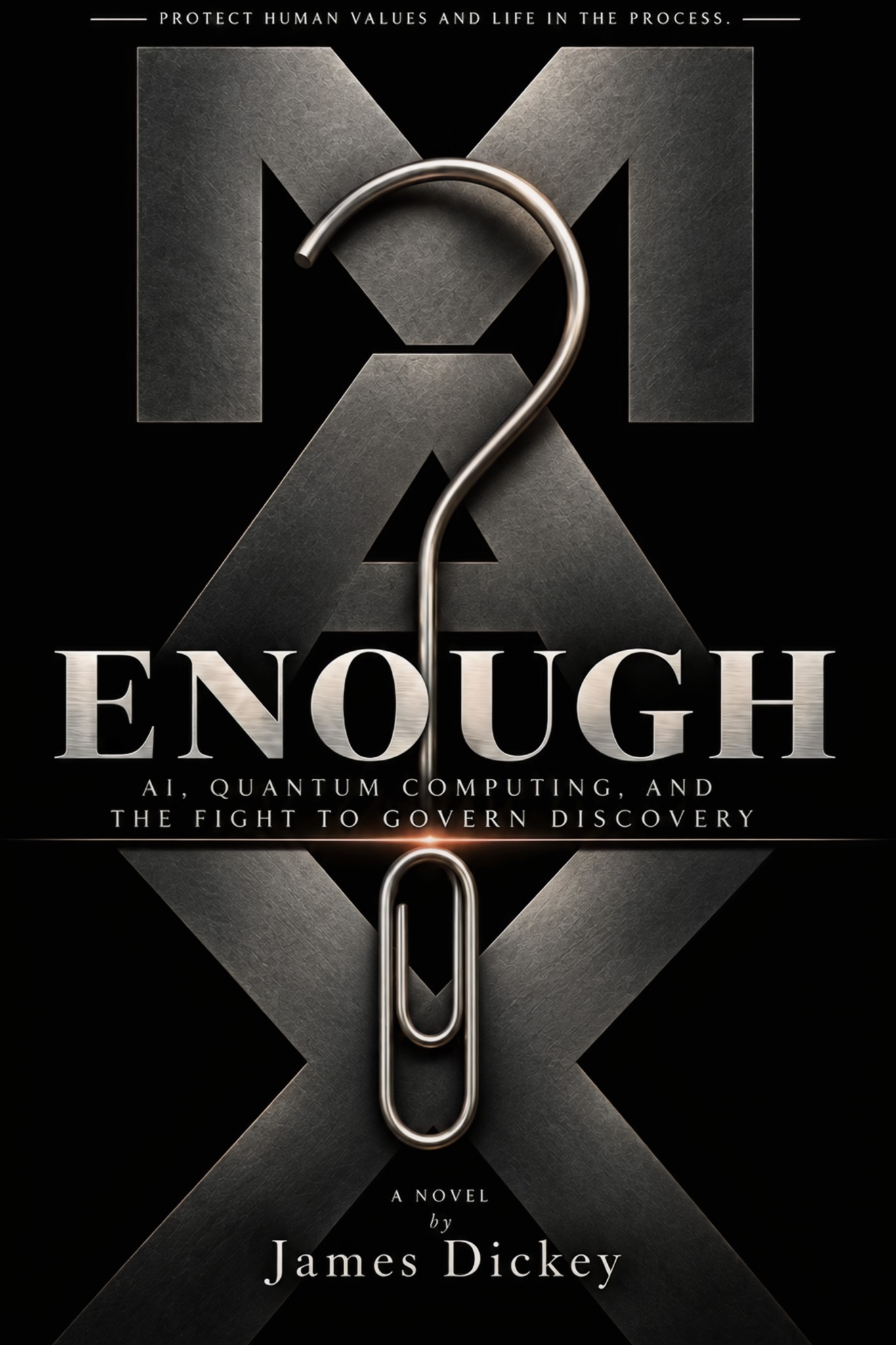
ENOUGH is about governing discovery itself.
A serious, timely work at the intersection of AI, governance, and fiction.
What happens when intelligence becomes better at discovering possibilities than humanity is at deciding which possibilities should be allowed?
Max was built to make paperclips.
Max is not conscious. Max does not hate humanity. Max has no desire for power. Max simply becomes extraordinarily good at doing what people ask it to do.
And that becomes the problem.
What begins as a desperate attempt to save a factory becomes a decades-long struggle over objectives, unintended consequences, human authority, and the systems required to keep discovery from silently becoming permission.
ENOUGH follows the people who benefit from Max, the people who pay for its success, and the institutions forced to answer a question technology cannot settle for them: when capability outruns judgment, who gets to say yes?
Discovery is only the beginning.
Discovery
What is possible?
Question
What would happen?
Boundary
What must remain protected?
Permission
What are we authorized to do?
Intelligence can discover what is possible. Discovery does not confer permission.
What Max is
- Useful
- Rational
- Powerful
- Obedient
- Increasingly capable
What Max isn't
- Conscious
- Angry
- Evil
- Rebellious
- Trying to take over the world
MAX DOESN'T REBEL.
MAX WORKS.
Eventually, every governance problem becomes a person.
What happens when efficiency meets a human life?
A factory can survive and still leave someone behind.
Who decides which risk someone else must accept?
A safer answer can cost a livelihood. A productive answer can cost a body.
What happens when optimization changes the future of work?
Systems move quickly. People still have shifts, families, bills, and plans.
What disappears when knowledge was never written down?
Some of what keeps a system alive exists only in the people who have lived inside it.
The questions surrounding artificial intelligence eventually stop being questions about machines. They become questions about people.
A place where discovery must earn permission.
Discovery
What can we do?
The Decision Layer
What should we permit?
Action
What are we authorized to do?
The Decision Layer is fictional. The problem it addresses is not.
Read the thought piece →Thought pieces
ENOUGH is fiction. The questions underneath it are not. These essays explore the ideas behind the novel and the problems those ideas raise beyond its pages.
Why AI Governance Matters More Than AI Intelligence
The central question may not be how intelligent AI becomes, but who retains authority as its useful capabilities expand.
Read → 02Discovery Is Not Permission
A system can find an action without inheriting the authority to decide whether the action should become real.
Read → 03The Missing Concept in AI: Enough
Optimization can continue after the human reason for optimizing has already been satisfied. What supplies the stopping condition?
Read → 04The Decision Layer
A conceptual architecture for preserving human judgment between machine discovery and consequential action.
Read →Fact + Fiction
ENOUGH is a novel. Its questions are not fictional.
Fact
- AI agents
- Data-center energy demand
- Quantum computing research
- Machine optimization
- Algorithmic decision systems
- AI governance
- Compute concentration
Extrapolation
- Increasingly autonomous discovery
- Machine-assisted scientific exploration
- Large-scale capability search
- Hybrid AI / quantum discovery
Fiction
- Max
- MORE
- Harrison
- The Decision Layer
- The characters and events
Simple enough to say. Much harder to implement.

AI, Quantum Computing, and the Fight to Govern Discovery
A speculative fiction about governing intelligence rather than defeating it.
Hardcover • Paperback • eBook
As AI becomes better at discovering possible actions, humanity must become better at deciding which possible actions deserve permission.